
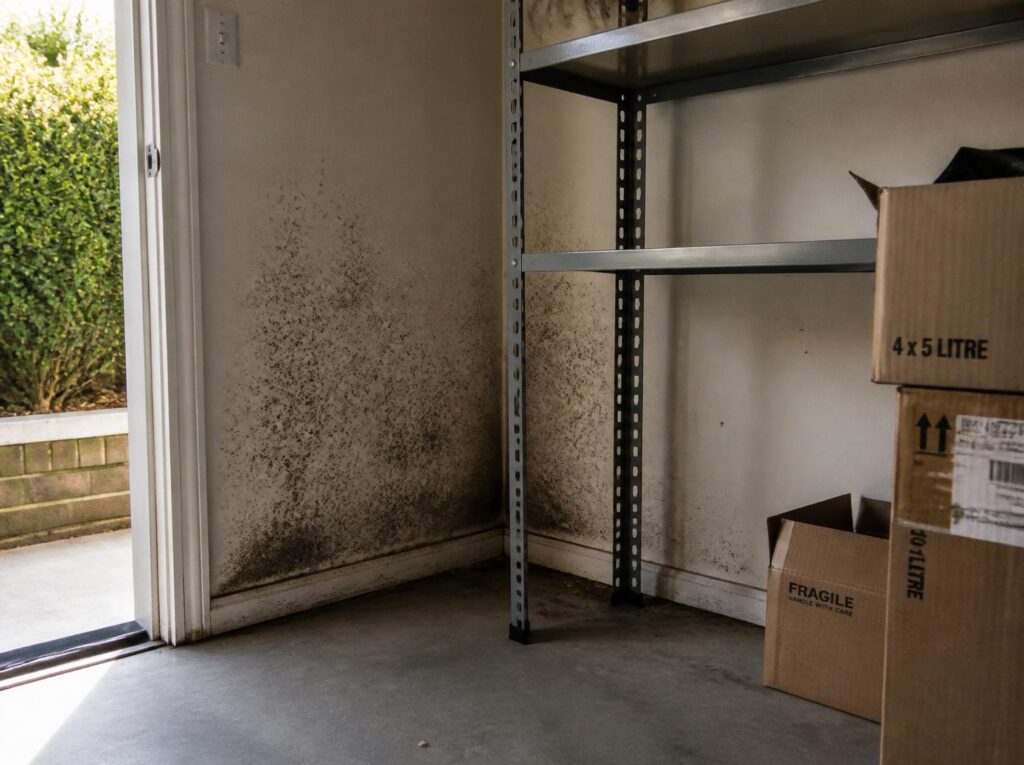
The call usually comes in around August or September. Someone has walked into the back office on a Monday morning and noticed the place smells damp. Or a cleaner has pulled a filing cabinet away from the wall and found the plasterboard behind it speckled black.
Nine times out of ten, whatever they’ve found has been growing quietly since June.
That’s the awkward thing about mould. It doesn’t give you much warning, and by the time anyone can see it, it’s already had a couple of months to settle in. On a commercial site that’s a bigger deal than it is at home. You’ve got staff complaints and WHS obligations to think about, air quality, damage to fit-out and stock, and in some cases lease conditions that you’re quietly in breach of.
Winter does most of the work
Mould really only needs three things: moisture, something organic to feed on, and time. Winter hands it all three at once. Buildings get sealed up. Doors stay shut, windows stay closed, ventilation drops right off. Heaters run, which creates warm indoor air that condenses the second it touches cold glass or a cold external wall. Rain finds its way into roof cavities and around slab edges. And because everything is colder, anything that does get wet stays wet a lot longer than it would in January. Now think about what a typical commercial fit-out is actually made of. Plasterboard. Carpet underlay. Ceiling tiles. Timber joinery. All of it organic, all of it perfectly happy to feed a colony.
Where we look first
After fifteen years of these jobs, the same handful of spots come up again and again: * Behind and underneath fixed joinery, especially reception desks and kitchenette cabinetry sitting against an external wall * Window reveals and sills, particularly on the southern side of a building * Ceiling tiles near air conditioning diffusers, where condensate drips or airflow is poor * Storerooms, comms rooms and back of house areas that nobody opens from one month to the next * Carpet edges and skirtings after any water ingress, even a small one that looked like it dried out fine Here’s a rule of thumb worth remembering. If a space smells musty but looks clean, the problem is almost always behind something rather than in front of you.
Why scrubbing it off never works
The most common mistake we see is people treating mould as a cleaning problem when it’s really a moisture problem. Bleaching the patch takes the staining away, and for a week or two it looks like you’ve fixed it. But the spores are still there, the material underneath is still damp, and the leak or condensation that caused it in the first place hasn’t gone anywhere. So it comes back, usually worse. Dry scrubbing can actually make things worse in the short term too, because disturbing a colony sends spores into the air and through the building. There’s also the plain physical limitation. You can wipe down tile, glass and sealed metal. You cannot clean the inside of a sheet of plasterboard or a piece of carpet underlay. Once those are contaminated, they come out.
What proper remediation involves
On a commercial site, a decent scope of works usually looks like this:
1. Find the water first.** Thermal imaging and moisture meters tell us what’s wet behind the surfaces, which is often a much bigger area than the visible staining suggests.
2. Contain the area.** We isolate the work zone and control the airflow so spores don’t get pushed through the rest of the building while we’re working.
3. Remove what can’t be saved.** Affected plasterboard, insulation, carpet and underlay.
4. Treat what’s left.** Antimicrobial treatment of the remaining structure and surfaces.
5. Dry the building properly.** Dehumidification and air movement, monitored until materials are genuinely back to normal moisture levels rather than just feeling dry to the touch.
6. Clean, check and document.** A detailed clean before anything goes back in, plus the paperwork your insurer or building owner is going to ask for.
Most of this can be staged after hours or zoned off so you keep trading. That’s usually the first question people ask, and the answer is generally yes.
Worth doing before summer
A few things that cost very little and save a lot: * Clear your gutters, downpipes and roof drains before the next big rain event * Get the air conditioning condensate trays, drains and filters serviced and looked at properly * Open up the storerooms and back of house areas and get some air moving as the weather warms up * Log every leak, however minor, with the date and what was done about it * Make sure your cleaning scope covers the condensation-prone areas, not just the parts of the building clients see * If somewhere smells musty, chase it down that week rather than waiting for something to appear on a wall
Not sure what you’re looking at?
Andes Management Services has been handling emergency restoration and commercial cleaning across NSW, QLD and VIC since 2010, and we work with insurers on this sort of job every week. We’re happy to come and take a look before you commit to anything.
If you’ve noticed a smell, some staining, or you’ve had water in the building recently, get in touch .
You can also read more about our restoration services and commercial cleaning services.